Wednesday, May 8, 2013

Special Request for Anna Maria

         Anna Maria hanging flowers on their door for the celebration of Dia Santos (our Halloween). All but one of these photos are from that day.


I have a special request that I would like to post. This request will only be presented once so I hope someone can respond to this need. For the past 8 years Carol and I have been helping a family close to Antigua. We began this relationship by sponsoring their daughter Anna Maria through Christian Children’s Fund. Besides providing tuition and clothes for Anna Maria we have help the family start a small store, connect to the municipal water system and bought them a cooking stove and bedding. Their life has improved year by year and it is great to see this growth. In comparison to the families we work with in the Ixil region this family has a much higher standard of living. They have running water, a three room concrete home with a fence around it. Yet they have encountered a financial difficulty that jeopardizes their security. Last February Oscar, the father, became ill and needed an emergency operation. This was a potentially life threatening illness involving stones from his liver.and the family made a quick decision to take out a loan of $1330 for the operation to remove these stones. This loan has a “grace” period of two months with only 10% interest. In May it increased to 20% per month.  This kind of high interest rate is not uncommon in Guatemala but is a horrible burden to the poor. What I am looking for is someone to give Oscar a new loan. He has returned to work now and has the ability to make payments of $60 per month which would be personally managed and guaranteed by myself, not TRE. The mission statement of TRE directs us to use our funds to work in the Chajul region so this is outside of the scope of TRE and personally I do not have the finances to do this loan at this time. If this touches your heart please consider helping protect the gains this family has made and contact me.
Here is an earlier photo of Anna and one of her sisters and mother weaving while she studies. The building made with small poles in the background is now a concrete block bedroom with cement floor.

Their family lives in San Antonio Agua Caliente which is only 30 minutes from Antigua. This area is famous for its weavings. Look closely at the design of Sandra's weaving. It is an intricate picture of birds in the forest and will take her 60 days to complete. After she finishes she will sell this to a co-op for $175. Two years ago they sold for $200. 


But the day most of these photos were taken were for the celebration of Dia de Santos. Here we get to eat tamales. Maria's brother Marvin is pictured here reading a manual from the company where he works. It is a national company which encourages it's employees to be active in their communities and has vacation pay on this holiday. He might only be making gunny sacks but is very fortunate to have a good employer. Most of the improvements on their home are due to his help.


Maria in front of their kitchen ready to go to the cemetery and place decorations.
Her grandmother is tending the grave of her husband. Her passed away last year. For Guatemalans Dia de Santos is like our Memorial Day in which we remember our loved ones and decorate their graves.

Finally here is Oscar getting water to fill the flower vases. You can see by the care put into this wealthier part of the cemetery how important caring for these sites is to the families. 

Oscar looking over Maria at a well tended family grave.

There are many traditions in this celebration. All during the day favorite foods and bread are set out for the fiesta. Early in the day a candle and incense are lit to symbolize their prayers. 
Today I called Beatrice and told her I was posting the request and this would be another good day to light them again. 
UPDATED NOTE: We have a sponsor for this loan. When I called Beatrice the next day with the good news you could immediately hear the gratitude and relief in her voice. We even had multiple offers which demonstrates the good caring hearts of our readers. Mucho Gracias.

Friday, April 19, 2013

GARDENS REVISITED


I have just returned from six weeks in Guatemala and what a fantastic trip it was. As I start to go through photos and project reports I realize I just don't have enough time to share all the intense experiences that come on these visits. We are working at such a rapid pace that by the time I would get halfway through my blog reports it would be time to head back again. I am going to have to simplify the reporting so that I can share some of the amazing progress that is being made. Although these reports will be simpler and a little "raw" I hope the depth of what is taking place comes through. I am amazed at the changes I see. I started this work with the vision to "Change the World". A grand and lofty thought that did not really seem possible. Now I have become a believer. Yes it is possible to change this small part of the world and to a much greater extent than I ever dreamed. 
During my first week in Chajul I took a walk to visit our different villages and projects to get a feel how things were going. This is some of the progress I saw in our garden project.
 
Here is a photo of Francisco the village leader of Xesalli's garden in late November. It has a lattice work of wisquil growing above Francisco and the plant with the arrow shaped leaves is Malaga, a starchy root crop. (Wisquil is a vine that produces a large avocado shape fruit with the texture and taste similar to eggplant. It is highly productive and a great annual plant.)Both of these crops can be grow outside of a fenced garden site.

Wow! Look at the difference! This photo was taken in March just three and half months latter. He has opened the site up to receive better sunlight and has seven different vegetables growing. Fransico and 23 other families in Xesalli are now in what we call the Phase II. Phase I is the distribution of seeds and a little bit of instructions. For Phase II we select those who have done a good job in the first phase and give them enough wire for an eleven meter by eleven meter garden spot. By the time  I left Xesalli to return to the states Francisco and 23 other families had finished fencing their new garden sites with the wire we have provided. I can hardly wait to see them again in November.

When I entered the village of Nueve Puntos this was my first sight and I thought wow what have we done. Every home has a large garden site. These fenced sites were started in December 2012 but we have been providing seeds here for two years.
Pedro's bush beans are feeding both his family and his soil through their nitrogen fixing abilities
Here Mat is picking some greens for our lunch. Every meal I ate in this village had a healthy amount of fresh vegetables. They are so happy and proud to share a meal with what they call the vegetables of Pa Mik    
( Senor Michael)
 
We ate swiss chard, turnips, sweet peas, onions, kohlrabi, broccoli and summer squash.
Meals that once were just beans and tortillas now had more flavor and twice the volume. They are full of nutrients. I was so excited to see this progress. We are just getting started but what a good foundation.
 Word of this program's successful beginning has traveled fast. Here is Ann from a different village, she is excited to get started on her garden. She is a single mother that I have noticed is well respected when she speaks in different village meetings.
 She is not afraid of work. Here she is carrying a small log to use as a border for one of her garden beds. We are teaching the value of raised bed gardening because it protects the soil from compaction, allows us to dig and place all the available topsoil where the plants are growing, and plant the maximum number of plants in a given space.
 Her oldest son Pedro lays another border with rocks.
 While another sibling brings in a load of topsoil.
Seeds, amaze me. They are so small but have the power to produce so much. Each of the packets beside Pedro hold a new variety of heirloom seeds. Many gardeners have adopted my method of planting  small seeds by pushing seeds out of a spoon with a stick. This method allows us to place each seed in it's designated spot. Even though I might have over one hundred pounds of seeds with me when we distribute seeds if we drop a few on the ground they are always picked up and saved. This high value that the villagers and I share for seeds is something I do not want to loose.
We are instructing each gardener to have one area for a nursery. This bed will start around 100 plants which can be transplanted in three weeks. They can then replant the nursery to start another cycle. This will give us continual harvest throughout the year. This bed  holds 10 new varieties of seeds from Territorial Seed Company in Oregon.

Here I am giving an gardening class in Las Flores. I a sharing the special characteristics of a new variety of seed and offering to buy back seed from healthy robust plants in the fall. The villagers  understand the value of and how to  save seed as they have been passing down seeds for many generations.
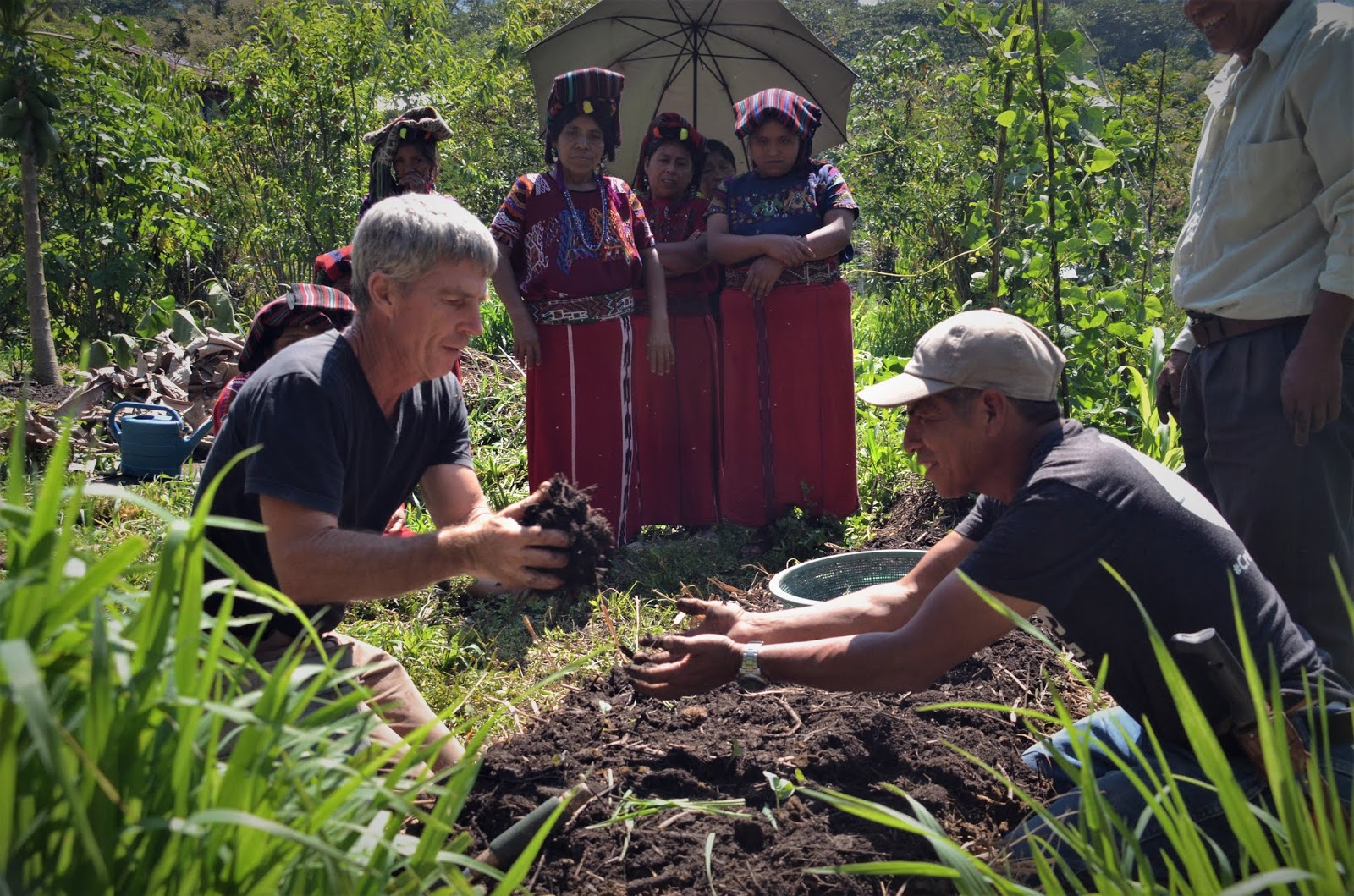
TRE is also teaching how to organize a garden site, the value of  composting, mulching, having a nursery in the garden and much more. It is really exciting to me when a good idea is presented to hear the discussion that follows in Ixil. It gets louder and faster as each person shares their opinion. 
  How can a spoonful of seed produce so much joy? I really love being a part of this work. What could be better than loving and helping people in need?

We have printed what type of seed and basic planting instructions on return address labels and then stuck them on resealable bags. This is a big improvement and time saver compared to our original method of hand written notes and seeds wrapped in newspapers.
Passing threw the line of seeds this man picks up a packet of each variety and a roll of string to tie up poles for pole beans and peas.
A hat full of seed represents a lot of food.
 Well there is no end to the photos or stories but this blog is getting a little long so let's make a quick pass through some garden and visit some friends. Here is Kat a widow in Caba. This is what she did with our first phase of seed giving.  Not a bad return for the investment of $5 worth of seeds.When I left in April you could not see the back fence the peas were so high.
 Andres in Nueve Puntos. He had some great looking kohlrabi ready to harvest yet did not what is was or how to eat it. Now he love kohlrabi and has two different varieties. We also provided rainbird sprinklers for this village. When I ask how they liked them they said they didn't know how to work them and ask f I would show them how. I thought this was strange because I felt surely everyone understands how to use a sprinkler. We then hooked one of the sprinklers up and I told everyone to stand back as we were going to turn it on. Well they didn't. It was hilarious watching them laugh as click,click,click the sprinkler advanced and then sprayed their neighbor. It was even funnier to watch the shock on their faces when it just keep coming and then sprayed them. By the second round everyone had caught on and ran back but not far enough so a second spraying finished our bath and lesson. Now they know how to use a rainbird sprinkler!
Maria Lopez and some of her gardeners in Chel using baskets for seed beds.
This garden is full and ready to be expanded.

Antonio with his first phase garden.
 These three photos are of Pa Lu and his wife's garden in Xeq'ano. Xeq'ano is a new mountain community carved in the midst of the forest.
 Here are sweet Oregon sugar snap peas. He grew them all so he could save seed for next year.
Look closely for the people in the bottom of the photo and you can begin to sense the size and wildness of his garden. This is what he did with that first phase of seeds.
 This young mother is one of our new gardeners in our third and newest group in Chel. She had two plots ready for seed.
 Here she has made a fence out of rocks to try an protect a few plants.
This is her home and two other gardeners in this group. When I see such a strong desire to have a garden and so much need I am grateful that we are able to help. Through your support we provided wire and seed for this group of 10 women. This brought our total number of gardens to 98. 
 98 gardens, 98 partners,98 friends and we are only just getting started. I can't express how happy I feel. How hopeful I am. A vision has been seeded and we get to watch it grow. Please join us in this venture. We are planing a four year program to establish good garden practices and build up the basic tools and infrastructural to make this a success. 1000 fruit trees and bushes are coming by this fall and we already have a waiting list of people wanting to garden. Just under $50 allows us to fence a site and provide them with seeds. This is the most expensive part of the program but puts the garden in a central and permanent position in their lives. Only time will tell how great of a gift one garden can be.


Sunday, January 13, 2013

Personal Gardens


Those of you who know me and have been to my house understand that one of my loves is gardening. Most evening during the growing season you will find me playing in the garden. For years I have used a raised bed intensive style of organic gardening. By building great soil I like to see how much food can be grown in each bed. Recently I was watching a video on permaculture gardening and the author made the statement that everything he needed to fed himself grew within 75 feet of his house. My own personal garden is always producing more than we can eat and this has started me thinking. How can we promote intensive gardening in Guatemala that would turn their need for food into the same abundance I experience.

Illa--Seeds are precious, Here Pedro carefully hand a few to a friend to plant

So this year we are ramping up a small gardening program. Our vision is to see an abundance of good nutrition food on the table. This is not style of program that says here let me show you how it is done but one of sharing garden experiences, new ideas, seeds and tools. What hindrances do I find to good gardening in Chajul? 1.) Basic supplies- lack of seeds, the ability to water regularly, 2.)some basic understanding of spacing and soil compaction  3.) how to "grow" the soil through composting and green manures. 
Some of the following photos are of gardeners we have been working with, others of new families that are receiving wire for a 11 meter x 11 meter spot. We have provided wire for 50 gardens and have a goal for 50 more. The third group that we are helping only are receiving seeds and a little instruction. I feel like Johnny apple seed as I have traveled through different villages sharing seeds and gardening ideas. It is not a bad job at all.  Most of our work for 2013 will take place along a circular path that stretches from Chel to Caba ( the farthest village ) and back. In all there are 8 villages and the level of aid will very but we will be helping in them all. 

This is Maria Lopez who is head of a small group of women gardeners in Chel. She is holding a baby chaya plant and beside her are canastas or baskets which she has planted vegetable starts in. Behind her and growing overhead is a wisquill plant and to the front right are pole beans. This group of women are a joy to be with and doing excellent work.
Maria doesn't have much space and her health is not real strong but she loves to care for her plants. Here are some pea starts and chives.


Here is Juana Ijom who is one of the women in her group. Maria has done an excellent job in selecting and organizing this women. Juana has collards, onions anise and carrots growing in front of her home.


Juana Lopez Mendoza another of Maria's group has hung plastic flags in her spot to discourage birds from stealing seeds.
                                Tok va va chicon  I am planting beans
Here we are planting a new strain of bush bean. With three of our garden groups we planted some specialty seed donated from Territorial Seed Company in Oregon. The women are excited to save and share seeds from these new plants.
Magdalena Maton has a good crop of peas and carrots and her baskets are seeded with tomatoes, cabbage, broccoli, Swiss chard and other goodies. Buy seeding in baskets and small beds we can restock he garden beds with three or four week old plants after a harvest. There will also be starts to share with neighbors or seed the field with plants which are in excess of the space available by the house. One of our goals is teaching successive plantings for a contiguous harvest.  
This is Francisco the alcade/leader of Xesalli. He is entering the garden program this year and receiving enough wire to fence an 11 meter by 11 meter square. Each participant also receives more than enough seed to fill there plot. Notice his fencing. Pole fencing only last a year so by providing wire we are putting the gardens in a perminate  position of village life. These sites are also referred to as almasicos or nurseries. By caring for starts close to the house they can then carry the young plants into the hills to seed their fields.
This lean-to is at his fields in the mountains. It provides a place to get in out of the rain or cook a lunch  or even spend the night if they need to.  Many fields are far enough away from their homes that they will not be cared for a intensively as we would in a vegetable garden but they can be very productive.
I appoligise for the poor quality of the photo. My lens is dirty and I am shooting into the sun but I want you to see the potential of this project. Last year we gave Francisco some seed. He transplanted a few culish, a type of cabbage/collard plant in this rocky wet draw and let it go to seed. Now he has fifty plants that provide a free lunch or he can pick and take home for dinner.
Above the culish here are four tomato trees. They grow to 15 feet tall and produce a type of tomato for up to 12 years. Each bush bears between 50 to 200 fruits! TRE has a nursery growing 200 of these bushes for us as well as over 500 fruit trees that we will distribute this year. Also in this wild unkempt field are squashes and a pepper plant that grow to five feet tall.

Mat o' Nueve Puntos Let's go to Nueve Puntos
Let's keep moving. Here we are loading wire to head into Nueve Puntos. Seeds are inexpensive but our wire represents a investment of  $75 dollars per family. This year we will serve around 60 families.
On this four day trip to four villages we keep getting started late. The first three days we arrived to our destinations well after dark.

Dinner by candle light is always a special occasion isn't it.
Our seed factory
The next morning we divided seeds for all the families in the village. Two weeks earlier we had passed threw and seeded basket for transplants. Now every family would receive enough seed for four months.

Each type of seed is measured by the spoon full and wrapped in a piece of newspaper.
A label stating what type of seed it is is hand written and placed in the packet. This system has worked for us in the past but now that we are distributing over 10 types of seeds to over 200 families we are going to update with the computer. We will print labels on return address stickers with the plant type and spacing needs all written in Ixil.
We want to be generous with peas and beans seeds because they are such good soil builders. Each family received a cup of Chinese pea seeds. Peas are new to many locations and last week I received an excited phone call from Xesalli telling me they were growing good and please bring more seeds.
Here is Pa Lu. I believe he is 78 years young and can still work up a storm. He has his packets of seeds to plant his plot. A garden site in Ixil is called a Pe
Pe pa Lu cuni otzotz  Lu's garden site below his house
Here is his plot beside his house. It is a little rocky but has great sun. Take note of the rock with the poles leaned up against it

Qu phil qu u txava  Turning the soil
With a little community help we will get it ready for planting in no time. The community chose to do this for the two most elderly families.
Ava mal tze
They call this sembrando postes or planting fence post. You just keep pounding them into the ground.
Nim Seban Giant rock
With a half of an hour of pushing we had one less rock in the garden.
Unrolling the fencing. We are using barb wire to strengthen the chick wire between post. This is a good protection from pigs pushing against the wire.We are also encouraging the practice of planting a type of bush that will grow into a new fence post so in the future they will have live fence post that will not rot.
We are asking that each plot has a space dedicated for a nursery and another for compost. By bring leaves and organic matter from the woods and layering it with soil and if available manure we can build good soil. This pile is built on a bed of logs and the holes Andres is making act as chimneys and help speed the decomposition through better air circulation. We also are teaching how to make and use manure teas. 
And this is why we are doing it. Here is lunch. In the bowl are wisquil leaves and under the cloth wrap are tortillas. I get many special meal of thanks on my trips as they give me their best so I know I eat better then their family but I always lose weight. The first thing I do when I leave Chajul is eat, eat eat. Not because I don't like their food but because there is not enough.  If we can build good fertile soil, teach proper spacing and care of plants, establish seed banks this table will be full of good food every day.
Time to move to another village.
Ava illa Planting seed
Diego Maton in the village of Xezaj. Xezaj is a new village with only five families living there.There is no water here and they are just starting out clearing land and building their homes.

Diego and Francisco inside their home with their family

And off to another.
80 families in Caba and Alguna Caba received seeds and blankets. We will start a water project in these two village this March
These blankets were donated by Miracles In Action which is also helping fund part of the garden program. We will watch the work of these gardeners and then select a core group to train and use to teach others. When our fruit trees are ready we will pass threw these villages and give each family two trees.
And off to one last village.
Xecon O' there are 15 families here. The women asked me if they could have the empty cans which I was saving for our seed bank in Chel. When I looked around their homes and saw how valuable they would be we decided to split the treasure and I took half to Chel and left half with them. This is another village that we are studying how to provide drinking water to.
In February I will be going back. We will bring more seeds, share gardening experiences and start on water projects for 100 of these families. They have lived for years on the edge but hope is growing. It takes work but they are not afraid of that. Let's give them the seeds and tools for a better tomorrow. Some tools we will bring are small shovels, rain-bird sprinkler heads, watering cans and more wire. This trip we distributed over 115 pounds of seeds. The majority of that was Chinese pea and bean seeds. At least ten varieties were new to the Chajul region. We hope to bring at least 400 pounds on our next trip. We have order over 700 fruit trees and will plant 150 chaya plants. What amazes me about this is how great of an potential there is. When I plant one tomatoe or bean seed I harvest so much more. What will come in the years ahead as we help seed these lands? Please consider joining us in this work. 
Matin Adios